

portrait-of-woman-with-american-flag-on-background

Undocumented Immigrant or Out-of-Status Immigrant: Understanding Your Status

Immigration status in the United States is often complicated, with various terms used to describe people living in the country with different types of legal status, or none at all. As an immigration lawyer, I want to help you understand the specific terms that might describe your current status, since each one can affect what options are available for you. Today, we’ll go over the differences between being an undocumented immigrant and being an out-of-status immigrant. Though these terms might sound similar, they refer to different situations under U.S. immigration law. Knowing the distinction between the two can help you navigate your options and understand any potential pathways to legalization.

Undocumented Immigrant: What Does It Mean?

If someone is referred to as an undocumented immigrant, it means they’re living in the United States without legal authorization. There are two primary ways this can happen:

  1. Entering the U.S. without inspection: This occurs if a person crosses into the United States without going through a designated port of entry, meaning they weren’t formally inspected or approved to enter.
  2. Overstaying a Visa: Many people enter the U.S. legally with a visa, but if they remain after their visa expires, they’re considered undocumented.

As an undocumented immigrant, you’re living in the U.S. without formal authorization to stay or work, and unfortunately, you could be at risk of deportation if you come to the attention of immigration enforcement. The process to legalize your status from here can be challenging but not impossible, especially if certain eligibility criteria apply to you.

Out of Status: What Does It Mean?

Now, if you hear the term “out-of-status”, that generally refers to someone who entered the U.S. legally but lost their lawful status by not meeting certain conditions. For example:

  1. Losing Employment-Based Status: If you have a visa that’s connected to your job, you may fall out of status if you lose that job or if your visa requirements change.
  2. Failing to Meet Student Visa Requirements: If you’re on a student visa, you’re required to be enrolled full-time in school. If you drop out, fail to maintain the necessary credit hours, or change institutions without following the correct procedures, you could fall out of status.

As an out-of-status immigrant, you might have options to regain your lawful status or adjust to a more permanent form of residency, especially since you originally entered the country legally.

Key Differences to Understand

1. Pathways to Legalization

  • Undocumented Immigrants: Your options to change your status can be more limited if you entered without legal authorization. However, pathways do exist, especially through family-based petitions, humanitarian programs, or even certain employment-based visas in special cases.
  • Out-of-Status Immigrants: If you entered the U.S. legally, you generally have a wider range of options to adjust your status and regain lawful residency. This could include switching to a different type of visa or, in some cases, adjusting status within the U.S. without leaving the country.

2. Risk of Deportation

  • Undocumented Immigrants: Without legal authorization to stay in the U.S., you may be at higher risk for deportation if you’re detected by immigration enforcement.
  • Out-of-Status Immigrants: You may be somewhat safer if you’re actively seeking ways to regain lawful status. However, if no action is taken to adjust your status, you could still be deportable.

3. Work Authorization

  • Undocumented Immigrants: You generally do not have the legal right to work in the U.S., although some limited programs, like DACA, do provide temporary work authorization.
  • Out-of-Status Immigrants: Depending on your previous visa, you may still be eligible to regain work authorization if you can adjust your status.

Options for Each Category

If you’re an undocumented immigrant, you might qualify for certain relief options, like family-based petitions (if you have close family members who are U.S. citizens or permanent residents), marriage to a U.S. citizen, or, in some cases, asylum or humanitarian programs like Temporary Protected Status (TPS).

If you’re out of status, your options to adjust status often include different types of employment or family-based visas, or even adjusting within the U.S. based on your initial lawful entry. Many out-of-status immigrants find a solution by changing or reinstating their visa status or moving to a more permanent residency category.

What This Means for You

It is crucial to identify your specific status so we can explore your available options. Knowing if you’re undocumented versus out of status shapes the type of applications you might be eligible for, your options for work authorization, and the level of risk you face for deportation.

Questions About Your Immigration Status? Contact An Experienced Immigration Attorney

It is important to consult with a qualified immigration attorney. They can review your unique situation, discuss your long-term goals, and create a plan to move forward. Call immigration attorney Jessie M. Thomas at (214) 838-0045 or schedule a consultation.

Who Can Vote?

Presidential Elections: Who Can Vote?

Who Can Vote in Presidential Elections?

Before You Start – Make Sure You Are Eligible!

Unlawfully voting in an election or claiming to be a U.S. citizen, in order to vote, is a violation of federal law punishable by fines and imprisonment. It may also affect your eligibility for certain immigration benefits and lead to removal proceedings. If you have any questions about your eligibility to vote, please contact an experienced immigration attorney.

To Vote In U.S. Federal Elections You Must:

  • Be a U.S. Citizen
    • Through Birth In The U.S.1
    • Through Birth Overseas To A U.S. Citizen Parent2
    • Through Naturalization3
    • Lawful Permanent Residents (LPRs) cannot vote in federal elections, though they may vote in some local elections.
  • Meet Your State’s Residency Requirements
  • Be 18 Years of Age On or Before Election day
  • Register to Vote by Your State’s Deadline

Some State Laws Place Restrictions on Voting Base On:

  • Felony Convictions
  • Mental Incapacity

If you have questions about whether you may vote in your state, contact the election officials in the jurisdiction (usually the county) where you wish to register and vote.

Ways To Vote

  • Vote in person at your designated polling place on Election Day
  • Vote early in person at your designated early polling place
  • Request a mail-in/ absentee ballot if available and vote by mail

1,2,3 View the printable factsheet for additional information on U.S. Citizenship and Naturalization requirements for voting.

Questions About Your Voting Eligibility? Contact An Experienced Immigration Attorney

Unlawful voting may affect your eligibility for certain immigration benefits and lead to removal proceedings. If you or your family members have any questions about your voting eligibility, it is important to consult with a qualified immigration attorney. Call immigration attorney Jessie M. Thomas at (214) 838-0045 or schedule a consultation.
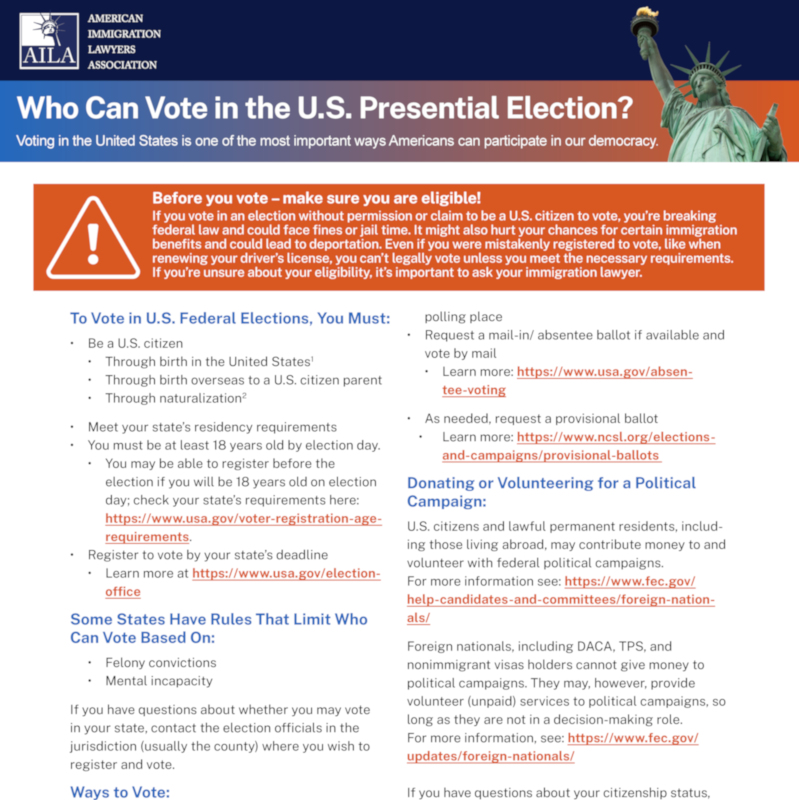
Printable Factsheet To Help You Understand Who Can Vote In The U.S. Presidential Elections

View online, download, or print and share with others

Who Can Vote in the U.S. Presidential Election?

Who Can Vote in The U.S. Presidential Election?

Medical Exam

Form I-693, Report of Medical Examination and Vaccination Record

If you’re applying for a green card in the United States, you have to submit Form I-693, which is a medical exam and vaccination record completed by a specific doctor. This form shows that you are not inadmissible to the United States based on health reasons.

A Form I-693 that is signed by the civil surgeon on November 1, 2023, or later does not expire and can be used for any immigration benefit application at any time in the future.

Note: if a USCIS officer has reason to believe that the applicant’s medical condition has changed since the civil surgeon signed the Form I-693 or that the Form I-693 does not accurately reflect the applicant’s medical condition, then the officer has the discretion to request further evidence or a new or updated Form I-693.

If I am applying for an immigrant visa outside the United States, do I need a Form I-693?

No. If you apply at a consular post, you will have a medical examination conducted by a DOS panel physician.

Can anyone complete the Form I-693?

Only a doctor listed on the USCIS website at www.uscis.gov/tools/find-a-civil-surgeon may perform the exam.

How much does it cost to have the Form I-693 completed?

Rates vary by physician. Do your research to compare what different offices charge. When scheduling the
appointment, tell the office that it is for an immigration medical examination.

What should I bring to my medical examination appointment?

  • Government-issued photo identification;
  • List of medications you are currently taking;
  • Vaccination records;
  • Proof of COVID-19 vaccination, if applicable;
  • Any other medical records, if available;
  • A current edition of Form I-693, available at https://www.uscis.gov/i-693

What happens at the appointment?

You’ll sign the certification at the start of the immigration medical exam to confirm that you agree to the exam and that all the information you provide about the exam is true. During the medical examination, the civil surgeon will perform tests for communicable diseases of public health significance and screen for certain physical or mental disorders, as well as for drug addiction and abuse. The civil surgeon will also make sure that you have all required vaccinations. Additional testing may be necessary.

When all testing has been completed, the civil surgeon will sign Form I-693 and put it in a sealed envelope.

IMPORTANT: Do not break the seal or open this envelope. USCIS will not accept Form I-693 if it is not in a sealed envelope or if the envelope is altered in any way. The civil surgeon should provide you with an additional copy of the signed Form I-693 for your records.

When will the Form I-693 medical exam be submitted to USCIS?

You may submit the completed medical exam with your green card application or later, in response to a Request for Evidence.

NOTE: Always check with your attorney before mailing anything to USCIS.

How long is Form I-693 valid?

A Form I-693 that was properly completed and signed by a civil surgeon on or after November 1, 2023 does not expire. A Form I-693 completed prior to that time is valid for two years from the date that the civil surgeon signed it.

Form I-693 Questions?

The information in this post is intended for general information purposes only and does not constitute legal advice. You should not act or rely on any information in this post without seeking the advice of a competent, licensed immigration attorney.

For more information on how this might apply to your case, please contact immigration attorney Jessie M. Thomas at www.staylegally.com/free-immigration-case-evaulation/.

1 2 3 4 5 13